A historical take on the controversial series opens our minds to the dark past of the British Empire and the treatment of indigenous populations for political, economic and social gain.
By Alex Gingham-Lake
From “a racist cringe-fest”[1] to “the mother of all controversies”[2], The British Tribe Next Door was destined to cause an explosive response from both viewers and the media alike. Journalists from The Independent and The Guardianwere not shy in calling out the creators, and the Moffatt family themselves, over last week’s first episode which aired on Channel 4 on Tuesday 22nd October at 9:15pm.
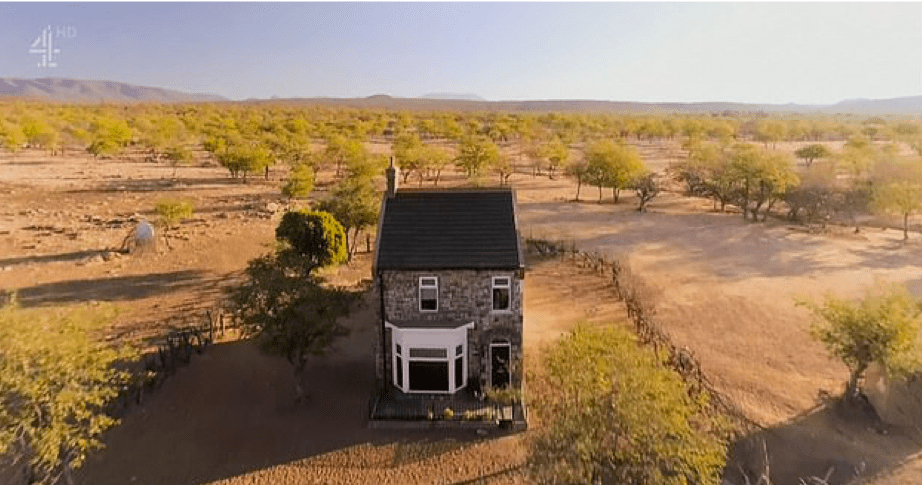
The premise of the series is as follows: in the quiet village of Otjeme, North-West Namibia, the Moffatt’s two-storey family home is replicated, with running water, electricity and two thousand of their possessions. Alongside the Moffatts are the semi-nomadic Himba tribe. Their interactions are filmed as both parties are exposed to the other’s way of life.
So, what exactly is there to add to the vast number of discussions already taking place on this series? We have been informed by newspapers that an “us-vs-them attitude”[3], “post-colonial arrogance”[4], and an “implicitly racist format”[5] are at its very foundations. But are we really aware of the insidious nature of Britain’s colonial past?
It is important to go beyond the journalistic use of pejorative labels and the good intentions of those who took part, in order to discern the parallels between this current form of television entertainment, versus the time of the British Empire.
For Your Viewing Pleasure: The Human Exhibition
The British Tribe Next Door exposes us to an alternative way of life and, like the Moffatt family, viewers at home can learn a lot from the Himba culture. For instance, being grateful for running water and placing less value on our material possessions. The women are fiercely proud of their traditions and feel lovely in their clothes; this proved to be the ideal context for Scarlett to learn the values of self-love and body positivity.
However, these points beg the following question: what exactly do the Himba people gain from the show? For British viewers, the entire experience is achieved from the comfort our of living rooms; it is the Namibian tribe who are brought to our television screens. Why should they be subject to our gaze, for the purpose of our entertainment?
Here, we find a parallel between the British Tribe Next Door and the human exhibitions of the 19th century.
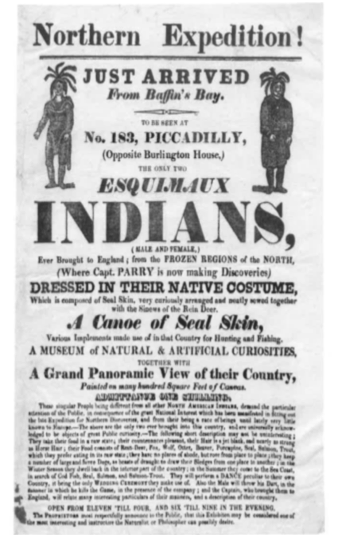
From “exotic shows” to “living curiosities”, the display of human beings took place from London to New York, and all across Europe.[6] They reached a peak in popularity during the 19th century, with London being a key host. Hundreds of indigenous people were imported, then displayed, for the education and entertainment of the British public.[7]
Dressed in their ‘native’ clothing, people were made to perform dances, songs and other ceremonies.[8] They were held behind wired fences, in theatres and in music halls.[9]
The purpose of such a presentation was to emphasise the “difference” between colonial subjects and the British public, which in turn legitimised racial hierarchies and exploitations within the British empire.[10] For instance, the notion that it was Britain’s “obligation” to bring “Western civilisation” to indigenous populations.
Much like the human exhibitions of the 19th century, The British Tribe Next Door presents the Himba Tribe to the British public, in order to depict a contrast between cultures. At the same time, the Himba people seem to receive little to no benefit from the experience.
Technological encounters
During explorations, the colonialist was fascinated by the indigenous people’s curiosity with European technology.[11]Photography, for instance, was a hugely powerful tool to the white explorer. It gave him a sense of cultural superiority in his ability to impress, but also to intimidate, those he came into contact with.[12] Scarlett and Betty Moffatt support their new friends through their discoveries of unfamiliar technology. However, it is difficult to look past Kandisiko’s discomfort as she makes her way up the stairs to the top floor of the Moffatt Home: “Are we climbing?” she asks Scarlett, “will we not fall?”
In Southern Africa, the natives believed photographs could capture the ‘self’, taking away a part of their soul; hence, many were afraid of such technologies. Photographers relished this perception, adding to their feeling of superiority.[13] In the programme, we witness a Himba tribeswoman’s confused gaze as she is confronted with her reflection for the first time. “Hello? Hello? I thought there was someone on the other side,” she explains. By observing this encounter, the public are effectively maintaining the colonial gaze of the photographers in the imperial era. The Himba tribeswomen’s confusion further emphasises to the public the distorted notion that Britain is somehow more advanced than other parts of the world.
Conclusions
Overall, a historical exploration of this show demonstrates how Channel 4 have been entirely irresponsible in their creation of The British Tribe Next Door. Unfortunately, it is only when we see this cultural exchange through the lens of the darker elements of British imperial history that it becomes easier to understand its insidious nature. It is impossible to ignore the parallels between the treatment of indigenous peoples in the contemporary era to the time of the British Empire. In future, production teams should be more careful in considering the wider historical context of such topics before creating such an insensitive show like The British Tribe Next Door, which ignorantly echoes the sentiments of our shameful imperial past.
It would be impossible to fully explore the complexities of the issues in this blog. Therefore, I encourage you to read Sadiah Qureshi’s Peoples on Parade: Exhibitions, Empire and Anthropology in Nineteenth-Century Britain for a deeper insight.
[1] Ed Power, ‘The British Tribe Next Door is a racist cringe-fest – but reality TV aims to offend these days’, The Independent, 24 October 2019, <https://www.independent.co.uk/arts-entertainment/tv/features/the-new-show-which-sees-reality-star-scarlett-moffat-live-with-a-namibian-tribe-is-gimmicky-and-a9169146.html> [accessed 29 October 2019]
[2] Ibid.
[3] Gabriel Tatet, ‘The British Tribe Next Door episode 1 review – the Moffatts had open minds, but it was all about their own issues’, The Telegraph, 22 October 2019, <https://www.telegraph.co.uk/tv/2019/10/22/british-tribe-next-door-episode-1-review-televisual-take-ebony/> [accessed 29 October 2019]
[4] Ibid.
[5] Lucy Mangan, ‘The British Tribe Next Door review – why did no-one put a stop to this?’, The Guardian, 22 October 2019, <https://www.theguardian.com/tv-and-radio/2019/oct/22/the-british-tribe-next-door-review-why-did-no-one-put-a-stop-to-this> [accessed 29 October 2019]
[6] Sadiah Qureshi, People’s On Parade: Exhibitions, Empire, and Anthropology in Nineteenth Century Britain (Chicago: The University of Chicago Press, 2011) p. 8
[7] Ibid., p. 4
[8] Ibid, p. 2
[9] Pascal Blanchard, Nicolas Bancel, Gilles Boëtsch, Éric Deroo and Sandrine Lemaire, Human Zoos: the Greatest Exotic Shows in the West (Liverpool: Liverpool University Press, 2008) p.3
[10] Ibid., p. 4
[11] James R. Ryan, Picturing empire: Photography and the visualization of the British Empire (Chicago: University of Chicago Press, 1997), p. 143
[12] Ibid., p. 143
[13] Ibid., p. 143
 Teaching Empire in Recolonial Britain
Leave a comment