
In this powerful blog post, Fahmida Begum explores the colonial resonances of adverts for ‘skin lightening’ products, and questions when we will move past the ‘white as right’ standard of both beauty and so-called ‘civilisation’.
Purity, cleanliness and goodness are just some connotations of the colour white. In a period where imperial expansion dominated, brands including Pears’ Soap thrived through profiting from the growing ideology of imperialism. The broader context of imperialism and increasingly hardened racial ideologies enabled an increased portrayal of racism in nineteenth century adverts. Incorporated within the Pears’ Soap advert of “The White Man’s Burden” were clear ideas of the superiority of the white race and the attraction of being white. One would assume that in striving for equality and diversity in the twenty-first century, brands would not be so overtly racist like Pears’ Soap. However, Nivea and Dove have done exactly that. The adverts have a strong ideological agenda, promoting white supremacy and associating whiteness with freshness and hygiene. Imperial expansion enabled a hierarchy of races, establishing the white race as the most powerful. Black and ethnic minorities have always been viewed as inferior in comparison to the white race and to have adverts produced within the last decade which enforce these views publicly, is alarming.
The Pears’ Soap advert highlights the ideological role of whiteness, enforcing the notion that white people are the only race that is capable of civilization. The term civilisation has increasingly been associated with the white race and western standards of life. This creates the idea that people of colour are inherently uncivilised and ‘backwards’ because they lack the same characteristics as the dominant white race. The advert suggests that the white man has a responsibility and duty to civilize others that are different from him because of the emphasis placed on the connection between whiteness and cleanliness.
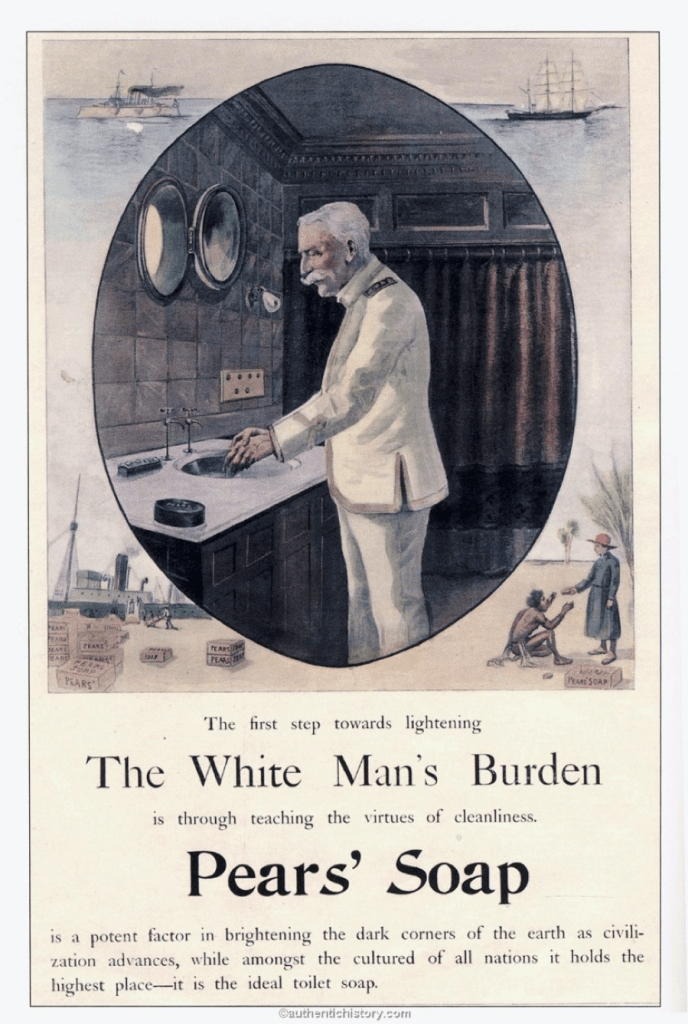
The dominance and the responsibilities of the white race to civilize is portrayed within the advert, with a man of colour positioned in a begging stance. The implication of this is that in the ‘dark corners’ of the world, the man is pleading to be saved by civilized humans. This presents a justification for imperialism because, it as if the superior white race is being asked to save others from misfortune. The nineteenth century advert creates the sense that purity, cleanliness and civilization can only be enforced by the white, western population. It also demonstrates the presence of the white savior mentality, that was becoming internalized among the white population within nineteenth century society.
Indeed, the Pears’ Soap advert which includes Admiral Dewey and references the “White Man’s Burden” was published in America’s McClure’s Magazine in 1899. The publication of the advert was a result of the victory of the Americans in the Spanish-American War during which the Americans colonized the Philippines. The marketing of Pears’ Soap focused on the endorsement of imperialism and the civilizing mission. As a result of this, buying products such as soap and particular brands of soap aligned with patriotism and was viewed as encouraging white superiority. The Pears’ Soap advert therefore, worked by appealing to the pre-existing ideas in a populace, urging white Americans to embrace the civilizing mission wholeheartedly through the purchase of such soaps.
The source incorporates a reference to “The White Man’s Burden” which was written by an English poet, Rudyard Kipling and published in 1899 in the same magazine. It can be understood that the poem is commanding white men to colonize and profit from this action. The Americans understood “The White Man’s Burden” as a justification for American imperialism and this is reflected in the advert. [1] This is because the consumer is being persuaded to ‘lighten The White Man’s Burden’ through the use and purchase of the soap. Essentially, their brave men have been burdened with the responsibility of civilizing and bringing order to natives. The least Americans can do is to buy this product in order to help relieve the burden, as the soap will provide cleanliness which is one of the first steps in civilizing. The advert promotes an ideological agenda which fuses the notion that cleanliness can only be associated with the white race.
The conscious choice to place the Admiral at the centre of the advert, dressed in a crisp white uniform which is complimented by his white hair, further emphasizes the point that whiteness is the ultimate achievement because, this race is viewed as the most attractive, pure and civilized. This image that has been created is appealing to the consumer because there is brightness radiating from where Admiral Dewey is standing. It is a technique to persuade people to believe that white beauty, purity and cleanliness are all inextricably linked and something to strive towards.

Similarly, the promotion of the ideological agenda of associating white as something pure, desirable and clean has carried on into adverts produced in the twenty-first century. This is evident in the ‘White is Purity’ campaign produced by Nivea and Dove’s advertisement of a black woman turning into a white woman. This marketing decision creates the sense that people with a different skin tone in comparison to white, are unhygienic. The campaigns endorse the idea that people of colour desire to have white or brighter skin. This is because of the imagery of a black model enlightened when she is thought to have used the soap and is replaced by a white model in the Dove campaign. Similarly, Nivea’s slogan of ‘White is Purity’ supports white racial hierarchy and supremacy. This ultimately suggests that in particular, women of colour are uncomfortable in their own skin and these beaty products, produced by Nivea and Dove are essentially available to fulfill these desires of wanting to attain brighter and lighter skin. An argument can be made that the decision to include a person of colour within the Dove advertisement was just a simple way of ticking the diversity box. However, the company’s campaign failed to represent people of colour accurately, creating the idea that dark skin is somehow inferior and less pure than white. The advertisements suggests that people of colour require this soap and deodorant in order to cleanse themselves into whiter or lighter skin.
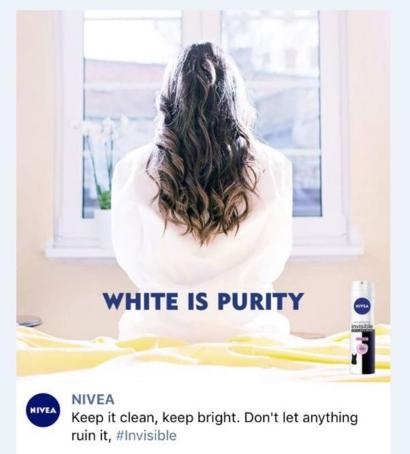
How long will people of colour and ethnic minorities be continued to be represented as inferior? In their adverts, the beauty brands have used the idea of the dominance of whiteness to make their products more appealing. Emphasizing the connotations of white as bright and pure enforces the idea that all other races are simply not good enough. They do not fit the western standard of beauty and purity. Despite the gap in the years of production, the adverts along with the Pears’ Soap advert share a similarity in that both present people of colour as inferior. Collectively, the message that is demonstrated is that those who are not white and do not have the ‘normal’ physical features of a white person, will always be subordinate because there does not seem to be a change in attitude towards diversity and representation. Although, Nivea and Dove have publicly realized the errors in their marketing campaigns, the consequences of the misrepresentation of women of colour, impacts twenty-first century society’s idea that the white standard of beauty remains the default. Not all people of colour are represented in the media and when they are, it is more likely that they are positioned as not only as the ‘other’ but also, less than.
The Pears’ Soap advert as well as the Nivea and Dove advert share striking similarities in that they present white as the top of the hierarchy. British and American imperialism and expansion created opportunities for businesses to profit from the idea that, white humans were brave saviors on a mission to civilize. There were obvious representations of the natives and people of colour as being inferior, due to their physical appearance and imperialism thrived off of these representations. It allowed for the white race to dominate and exert their authority, over people that they believed to be inferior because of the colour of their skin. Despite the progress within twenty-first century society in regards to ideas such as government policy, modern technology and science, the attitudes towards race on the other hand, share shocking similarities with the racist imperial society of the nineteenth century. People of colour continue to be misrepresented and it is simply unacceptable that even in our current society, the white standard of beauty remains the default. When will we learn and appreciate that people of colour are equal and deserving of accurate representation in society?
[1] Gretchen Murphy, Shadowing the White Man’s Burden U.S. Imperialism and the Problem of the Color Line, (New York University Press, 2010).
 Teaching Empire in Recolonial Britain
Leave a comment