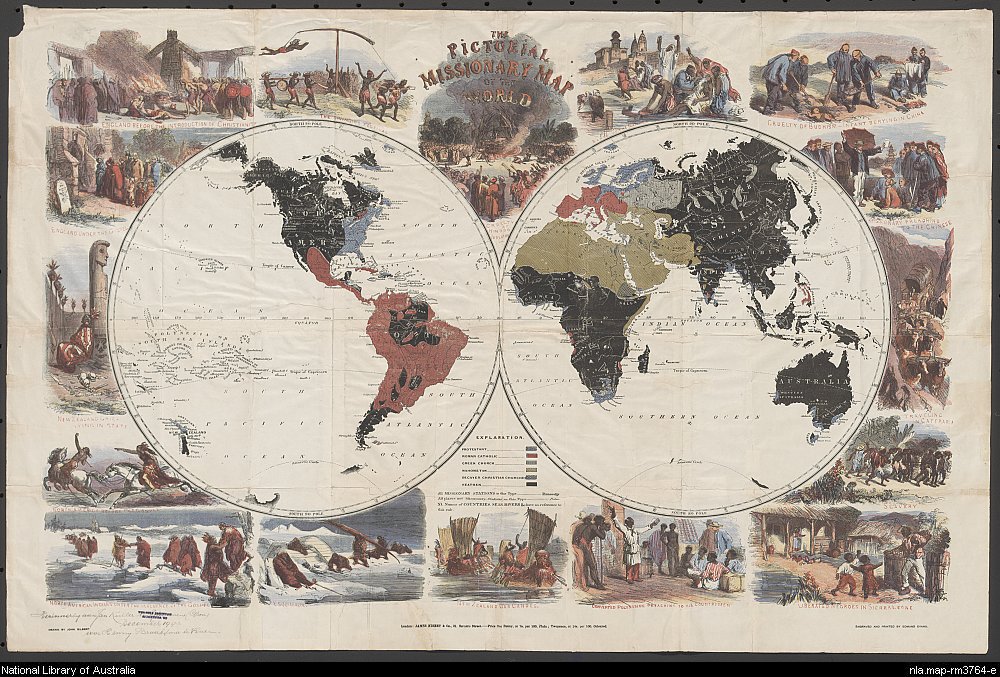
National Library of Australia website: http://nla.gov.au/nla.map-rm3764
Based on the research behind my first two academic monographs (Missionary Families: race, gender and generation on the spiritual frontier and Gender, Power and Sexual Abuse in the Pacific: Rev Simpson’s “improper liberties”) this module explores the history of Christian mission activity in the nineteenth century as implicated in histories of empire(s) and colonialism.
While often lampooned as victims of the cannibal’s cooking pot, nineteenth-century missionaries were part of a colonial project that transcended the boundaries of the British Empire. As agents in cultural and colonial encounter, mediators of knowledge between the grassroots of everyday empire and the armchair colonisers of Victorian Britain, and perpetuators of colonial dichotomies structured around hierarchies of inferiority and superiority, missionaries are undeniably part of the history of colonialism.
At the same time, missions were ridiculed and dismissed by imperialists of the age, prone to rejecting (or at least subverting) imperial power, and oftentimes thorns in the side of colonial administrators. While their imperial humanitarianism embodied the arrogance of colonial patriarchy, their role in education, medicine, community social practice and indeed campaigns against colonial abuses cannot be denied.
Even more to the point, being prolific writers, publishers and archivists, missions have left a wealth of primary source evidence and material culture, often relating to communities subsequently disrupted, destroyed or dispossessed by European colonialism. Like any archival footprint, the mission archive is an artefact of power in itself, magnifying certain voices while diminishing others (as I argue in Gender, Power and Sexual Abuse in the Pacific). Nonetheless, the mission archive is rich and varied, and provides an opportunity for in-depth study of nineteenth-century colonialism on the ground.
This module allows students to navigate that archive and interrogate the history of colonial mission from the eighteenth to the twentieth centuries. In so doing, students interact with issues of how we define imperialism, how useful the idea of cultural imperialism can be to the modern historian, and how we might talk meaningfully about ‘the colonising project’. They are introduced to the history of British cultural engagement and encounters with indigenous peoples within and outside of the empire; analyse and discuss the socio-economic, cultural and religious impact of Christian mission in the ‘age of expansion’; and tease out issues of cultural encounters, indigenous agency and resistance, race, racism and cultural chauvinism, and the impact of mission literature and experience on the British public’s own imaginative engagement with non-western peoples.
Their work on this blog reflects their primary source-led engagements with these issues.
 Teaching Empire in Recolonial Britain