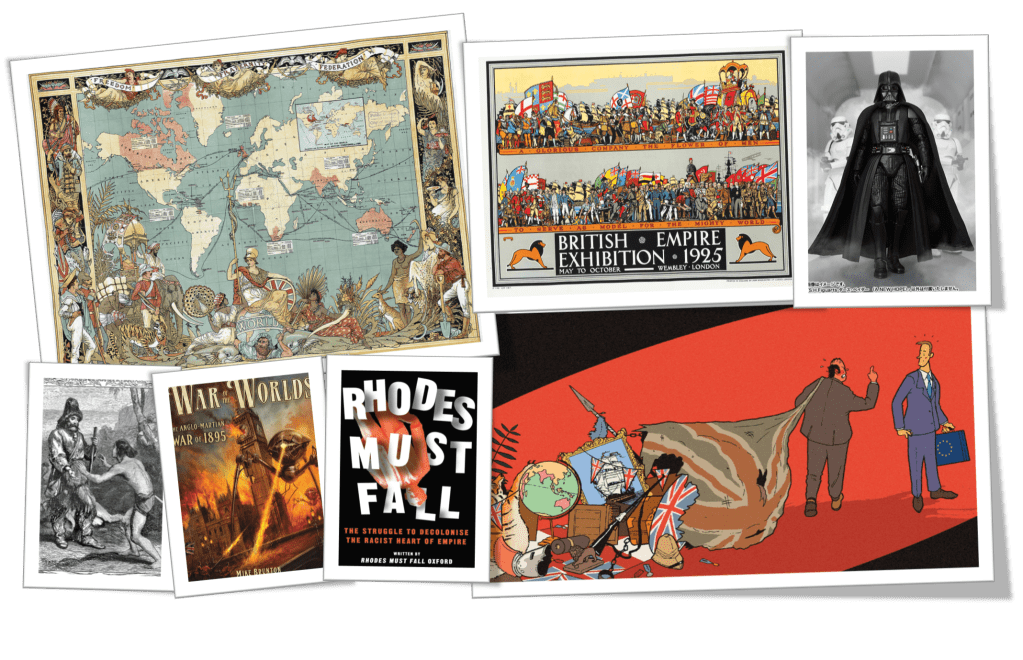
Based on my latest research on ‘Imagining, Remembering and Re-inventing Empire’ this module is taken by second and third year students at Royal Holloway. It offers a cultural and imaginative engagement with the ideas and realities of British Imperialism in the past, the present and indeed the future. Students use books, visual and material cultures, fiction, film and radio to explore the ways in which the British Empire has been imagined, understood and remembered from the eighteenth century to the present.
The module is split into three main sections:
Empire in the Victorian Imagination. The first part of the course looks at the way Empire was imagined and presented at the time of its existence. Taking the influence of empire on the cultural, political and national identity of Victorian Britain as its starting point, this teaching block explores the ideological content of the nineteenth-century ‘Imagined Empire’. Uncovering the ‘colonial common sense’ (Stoler) of Victorian Britain, colonial fantasies are critically deconstructed and exposed as national fictions that served to justify, applaud and perpetuate imperial power.
Remembering Empire in a Re-Colonial Present. The second part of the course explores the recent ‘nostalgia boom’ surrounding Empire in the present and the ways in which the imperial past is mobilised in modern debates. A nostalgic (and oftentimes inaccurate) re-imagining of Empire has taken hold in modern Britain. From Brexit to Biggar, Empire has re-entered the public conversation – assuming of course that it ever left. This teaching block explores the enduring cultural legacy of Empire in modern Britain, and investigates its ideological revival in the public conversation.
Re-inventing Empire Through Imagined Futures. The third part of the course looks at how imperial tropes and understandings have informed science fiction re-imaginings of the past through telling stories about the future. Science fiction has had an important role in reinventing and reframing the colonial past through an imagined postcolonial future. In so doing, however, it often does more to reinforce colonial epistemologies rather than decolonising them.
 Teaching Empire in Recolonial Britain